Wednesday, May 6, 2015

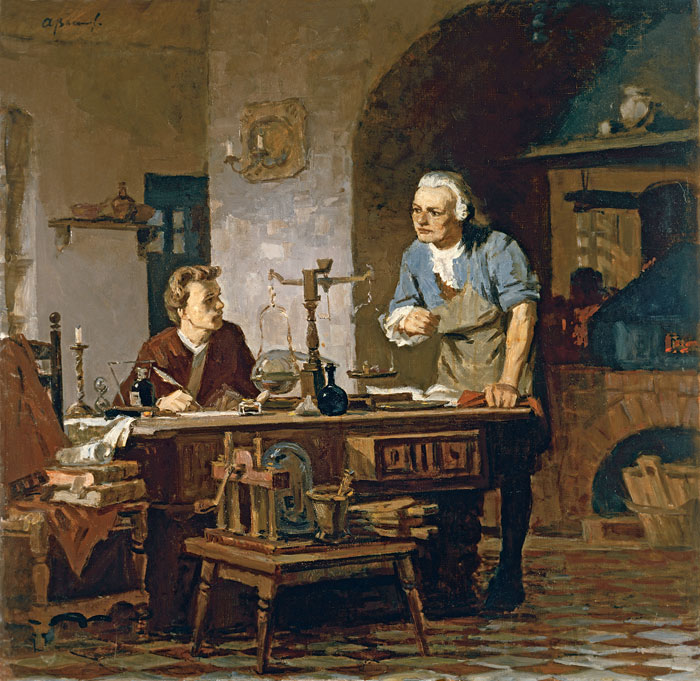
Dmitri Mendeleev


Dmitri Mendeleev (1834-1907)  is most well known for creating the Periodic Table of the Elements.  He was born in Siberia and later went on to become a professor of chemistry at the University of St. Petersburg.  Because he could not find a good textbook on the subject, he began writing his own.  The textbook only took Mendeleev two years to write (1868-1870), and laid the foundation for modern chemistry.  This may seem fast, but when he was only 27 it took Mendeleev 61 days to write a 500 page book on organic chemistry, simply because he thought Russia needed more chemistry books written in Russian, as many science books were still written in Greek and Latin.

Nothing was known about subatomic particles at this time, but atomic weights were known by scientists.  Mendeleev used this knowledge as well as knowledge of elemental properties to create a simple process for organizing the elements: “I began to look about and write down the elements with their atomic weights and typical properties, analogous elements and like atomic weights on separate cards, and this soon convinced me that the properties of elements are in periodic dependence upon their atomic weights.” 

Although some of Mendeleev's original periodic table was incorrect, he really didn't have much to work with.  Only 60 elements had been discovered at that time, and now we know of over 100.  In addition, he was working only based on atomic mass and observable properties and was still able to correctly place many elements and accurately predict elements that would be discovered later, such as Gallium.  Without Mendeleev, it is difficult to say that we would have chemistry as we know it today, and have made as many advancements based off of this knowledge.


Continuous Track

T-27 Soviet Tankette


A continuous track, otherwise known as a tank tread or caterpillar track, is a band of tread around two or more wheels that propels a vehicle forward.  This technology is highly important in the advancement of warfare, especially in the development of armored tanks, and in the advancement of agriculture, moving from hand tools and animals to the more efficient and quick tractor.
The tread on a continuous track is made of steel plates or rubber reinforced with steel wires.  Weight is distributed more evenly in vehicles that have continuous tracks due to the increased surface area tracks supply, and this enables such vehicles to move across soft and/or uneven terrain with a lessened likelihood of sinking or flipping.

United States M1 Abrams Tank
Russian T-90 Tank

In 1877, Russian peasant Fyodor Abramovich Blinov invented a "wagon that moved on endless rails".  His original design had horses pulling the wagon, and he received a patent in 1878.  He later created a steam powered tractor on continuous tracks; it was featured at a farmers' exhibition in 1896.  Although he successfully invented and got patents for a continuously tracked vehicle, the idea had been around since the late 1700s.  Only around forty years prior to Blinov's success, a Russian captain Dmitry Zagryazhsky received a patent for a similar tracked vehicle, but manufacturers weren't interested.


Thursday, April 23, 2015

"The Father of Russian Science"--Mikhail Lomonosov


Mikhail Lomonosov (1711-1765) left his peasant family when he was nineteen years old, taking only two books and three rubles, to study science in Moscow.  He studied at a boarding school for four years before being admitted to the Saint Petersburg Academy of Science.  He went on to become an academician (or professor), and fought to get more Russian students into the foreign scientist dominated school.

As a scientist, Lomonosov thought that the nature of things could be explained through the interactions between "corpuscles", which he called “minute, insensible particles”.  We now know these corpuscles as molecules.  Through this idea, he created the term "physical chemistry".
In addition, Lomonosov was the first to experimentally confirm the law of conservation of matter. According to Vladimir Shiltsev, "That metals gain weight when heated—now a well-known consequence of oxidation—confounded British chemist Robert Boyle, who had famously observed the effect in 1673. The result seemed to implicate that heat itself was a kind of matter. In 1756 Lomonosov disproved that notion by demonstrating that when lead plates are heated inside an airtight vessel, the collective weight of the vessel and its contents stays constant."


Other than these two most famous accomplishments, Lomonosov was the first person to freeze mercury, contributed to the kinetic theory of gases, got very close to the modern theory of continental drifts, created the first chemistry laboratory in Russia, and was the first to hypothesize that Venus has an atmosphere.  He went on to have numerous more accomplishments in the sciences as well as literature and arts.  Sadly, the great scientist contracted pneumonia and died at the young age of 53, but his legacy lives on in the names of towns and museums, and through all of the scientific advancement that he paved the way for.

Mikhail Lomonosov and the Dawn of Russian Science
Colloquium at Princeton Plasma Physics Lab
Russiapedia--Mikhail Lomonosov
http://max.mmlc.northwestern.edu/mdenner/Demo/poetpage/lomonosov.htm